
Ever since I read about Stand and Talks on https://www.saravanderwerf.com/ (The amazing Sara Vanderwerf's website) they have become the single most important routine/device/exercise/strategy I use in my classroom. You can also hear about them in this Global Math Department's webinar:
Just like warming up before exercising in earnest, like if you take a class at a gym or are getting ready for a race, the coaches ALWAYS warm you up. "Run 500 meters." Then we stretch and THEN we exercise, Stand and Talks open students up. They warm up their minds and activate an openness to learning through safe dialogue with a partner first. I love them. 

What is a Stand and Talk? 
Here is my proposal for the CPM 2020 conference: (Still holding my breath, I was rejected, but asking to be included in some other way--advise accepted)

Stand and Talks--5 minutes that will reshape your classroom culture

Think/Pair/Share is a common go to strategy to give students a cognitive boost.
But what if instead of sitting, you could create a similar, potentially richer, easy access,
sky’s the limit, non-disruptive experience moving and standing? Stand and Talks take five minutes
and will increases math discourse, always gives a student something to share out, and shifts the
cognitive lifting from teacher to student. 

Stand and Talks begin with a prompt to look at and hold so there are no awkward silences.
The directions are simple, the possibilities are endless. I have used them for review, preview,
introduction, and vocabulary. I have used them as an icebreaker with students and with colleagues.
I have used Stand and Talks with Notice and Wonder, What is the same and what is different,
Examples and Non-Examples, Who did it better, and What can you label?
I was introduced to the this strategy by Sara VanDerWerf @saravdwerf
and I can’t wait to share it with you! As Sara says, “My goal is for students to say it before I say it.” 

_____________________________________________________________________________________________________________________________________________________________________________________________________________________________________________________________________________________________________________________________________________________________________________________

My directions are modeled after Sara's: You will be standing up and pushing in your chair
when I finish giving you the instructions. You are going to move at least 15 steps away from
your table mindfully and quietly with no devices or writing utensils.
You will find someone to partner with that is NOT at your table. If there are an odd
number of folks, someone needs to find me and I will tell you what to do. When everyone is
partnered and standing, I will give you a card with a picture, graph, or problem on it. You will find
at least 5 things to say about what is on the card. If you can't find more, repeat the ones you have.
You only have 90 seconds so we are not going to worry about who our partner is and you will not
complain about standing the entire time.

I walk around and listen, make sure the students are on topic, nudge them in their thinking. I also
can have "plants" for the whole class discussion that comes after. When the 90 seconds are up,
I ask students to freeze and then I give them a silly instruction for who picks up the paper copies on
the table in front of the room. "The tallest replaces the card and gets two paper copies, the one who
slept the longest, the one with the oldest living grandparent, the one who lives closest to school...(see
the community building there?)

When the students get back to their seats, we annotate them together. This can reinforce, re-engage
or front load a lot of student thinking! The oohs and aahs are super fabulous and a lot of good information
comes from not just the top students. We then glue them into our Everything Notebooks (see earlier
post). And move on with our day. 5-10 minutes max. (We have 95 minute blocks every other day)


They look like this on a half sheet of card stock:

1) I used this S and T just as I was introducing graphing a quadratic by complete the square. in Math 2 (CPM) (Used as
review for all things quadratic in College Readiness):

Here it is annotated:


2) I used this Stand and Talk for introducing piece wise functions in College Readiness: Thank you @ cluzniak @math_mrestrada


3) This is a beautiful student generated Stand and Talk from College Readiness:

4) This is another student generated Stand and Talk from the Spring Final for College Readiness.


5) This is one of my favorite Stand and Talks EVER. I wish I had done a pre and post for Math 2. This was at the end of Right Triangle Trig.

Here it is annotated:


6) I admit, I completely stole the next one. I thank @NatBanting. I used this with Math 2 (and again with College Readiness) introducing the Zero Product Property. 


Anything can be a Stand and Talk. I saw this on Twitter and wrote that if you take out the
original prompt and replace it with "What do you notice? What do you wonder?" you get a
really cool Stand and Talk.


Here is another image from @riehlt:

Gotta Stop, going down the rabbit hole...

Is there anything I should add? That you have questions about??? 


Hi There! Thank you very much to the inspiration of @cluzniak and https://clopendebate.wordpress.com/ for this College Readiness Project. The class is Pre-Calc for the Liberal Arts--those not going into stem fields (they don't think), don't want to take AP Stats, and aren't strong enough for a STEM Pre-Calc class, but they do want to keep their math chops up after Algebra 2 and want to A) do well on their ACT and SAT's and B) place directly into a college level class.

The students had serious Senioritis. As bad as I remember it. I was getting 25% homework in. (In class they were fine, the students just didn't produce outside of class--Senior Project presentations feels like their capstone, and those were delivered April 24. For their final weeks I wanted them to be engaged in the math we had studied. I saw Chris' idea of using Margaret Wise Brown's, The Important Book for a project in his Pre-calculus and Calculus classes. "The important thing about a spoon is that you eat with it." I played some of it being read for the students on Youtube (Chris was much smarter and had each student read a section aloud). I then explained to the students we had a three part final:

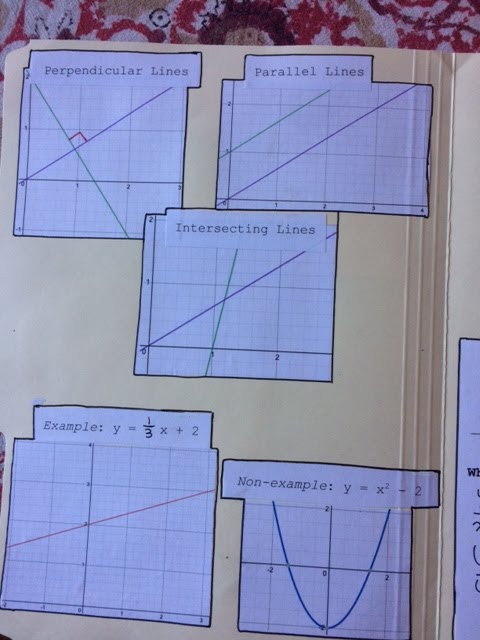
Part 1: Each pair of students received a manila folder. The cover needed the topic, and three facts or properties about the topic. The inside cover was a continuation of the properties and rules of the topic, or examples and non-examples. The back inside were two worked problems for the topic. I encouraged students to find an SAT or ACT question as one of them. And the back cover was a Stand and Talk (see https://www.saravanderwerf.com/stand-talks-the-best-thing-i-ever-did-to-get-students-talking-to-one-another/) with one blank copy and one annotated copy.

This worked fabulously. I gave the students 3 full classes to pick topics (each student pair got a number, then I random generated numbers for the pair to choose in the order their number came up) including choosing their topic, researching it, and having me print anything they needed.

Part 2: On the due date, the students made flip books with all the topics. They could use each other's "Important Books." They needed a minimum of five topics from the eleven, but they could have all eleven, because they got to use the information to answer Part 3 that was given on the day of the final.

Part 3: One non-cheatable non-replicable  question based on the role of a twelve-sided die and the number assigned to the ELEVEN topics. That is right, ELEVEN. So if you rolled a 12, you automatically got the 10 points. It was soooooo fun and the students really committed to the process. Some felt over confident given their flipbooks, but in general there was cheering, "Yes I got Lines," and total groans, "I got Logs, NO!"
I was really proud of the questions. Here is a sample:

Given a system of the equations of two parabolas, how do you know they will intersect and how many times. Be thorough in your investigation.

Given system of two linear equations, how do you know if they are parallel, perpendicular or neither. Be thorough in your investigation.

Can two matrices that can be multiplied, be added? Be thorough in your investigation.

How many arrangements of ice cream can Bella enjoy given that she has a choice of 24 flavors. 
Be thorough in your investigation.

We had one student roll a 12 and there was much celebrating for them. (pronoun preferred). 

Here are some pictures of the "Important Books." Next year I will make the cover facts say "Logs are important because you can use them to find out how much time it will take for you need to achieve a future goal." 

Taking suggestions for tweaks. I have the rubric if you want it.

Lines Cover
Lines Inside Cover
Lines Back Inside
Logs for Finance Inside 

Probability Stand and Talk
Logs Stand and Talk
Parent Functions Cover 
You know the boring lessons in Geometry about chords and tangents and the angles they form? 


Today I wanted to do something more fun than our usual good fun, and so I started these Chapter 10 topics with constructions of circles. 

"Let's use this tool and make some circles!" What else can you make with a circle? We did regular hexagon, Equilateral Triangle, 6 pointed star. 

Then the inspiration hit. I let them play. Meanwhile I started making circles and cutting out bits to look something like this:


Because I remembered an OLD geometry book that had this problem:
Remember that goodie? 

I handed everyone a piece and said, find the original size of your disk, your plate, your platter, your wheel, whatever it was that you found in at your dig site. 

I was excited, they were a wee bit...I will take it. At least they were a bit more open. I then gave each pair of students a property of circles poster to make. 
Happy Friday ya' all!

Hey There! @Druinok suggested I blog about how my colleague and I use a stamp sheet in class for student accountability and paper management. So here ya go:

I used to collect homework with an assignment sheet. 10 went on the student paper and 10 went on the assignment sheet. The stamp sheet score went on a paper grading roster and when I had time, the whole hot mess went into an online grading program. I was going mad! Can you imagine, when you didn't get homework graded and you had a kid's assignment sheet? OY!

Then I had the most amazing and talented beginning teacher ever! Ms. Danielle whipped me into shape in no time at all. (She is a Millennial, so no Twitter handle and I don't Instagram...so...) Heh, I was supposed to be her support provider. I taught her how to "sandwich--" a nice thing said, the real heart of the matter, and then another nice thing, she just made be better. Period. I digress...

Through trial and error, we came up with the all and one--EVERYTHING notebook. Syllabus, Notes, Stamp Sheet, Classwork, Homework, Toolkits, and Team Tests. You never run out of room, you never run out of graph paper (ha! it is graph paper), you never lose anything because it is SECURED into one handy-dandy spiral notebook.

The Notebook:
Through our district, I can get them for $2.00 each!!!
I ask Students for $2 donation, they know that is a good deal. They can even bring $.10 per month. Yes, I do end up eating about $5--

Page 1:
The Fun Title Page. This student loves her notebook.


Page 2: 
First Stamp Sheet for Assignments and Classwork per Unit. I only stamp for CLASSWORK. One stamp is that you are starting, working with your team, two means it all classwork is complete for the day. I stamp sometimes in the middle of class, sometimes at the end, sometimes at the beginning of next day. I only collect notebooks ONCE per unit and add up stamps. Takes less than 1 minute per. I can go through during Individual Test. If it is a team test day, I can also get through the entire class. Gives me a chance to check in with teams, check on students etc...


* Extra note about stamp sheet: You will notice sometimes it works great, sometimes I have to make adjustments due to inspirational moments, shortened days, reteaching, field trips, you know, life.


Next Pages:
Warm ups, Stand and Talks, Classwork (notes), Assignments (homework), rinse, repeat.


An example of the class pages we build for our CPM curriculum:


Well, you can see students do their own thing...sometimes I do too:


Assignment (homework grades): 
Students do their work in their notebooks. They come in, they get a key, they have red pens, they make homework corrections (and find my mistakes). I make it clear EVERYDAY, that my solutions are only a suggestion of how to complete the problem, there could be and should be more ways to do the problems. They can ask me if there solution is a valid one independently. They have rubric for assignment grades something like this: All red pen bc you didn't do it and are copying answers for later--3, some done, rest in red pen or no red pen because you didn't grade it--4, all done, all correct or all done and all correct--6. You can see this student makes all kinds of good notes.

Fun Stuff: Students get very creative about folding and securing the pages. They accordion them, they fortune fold them, they cut them out to make them fit better.

Not So Good Stuff: Some students get very behind in gluing things in. These are the students who stuff everything in their backpacks and ask for a new handout every day and usually have three or four of the same thing in their bags. They also are the kind of kid who has done their homework but can't find it. At least the Everything notebook helps in that case. Once or twice at the beginning, I will sit with these students and we will sort and glue. (I go through a lot of glue sticks!) (oh, and I love double stick tape.)

Sometimes absences can be troublesome, but I have all the handouts by day in milk carton and hanging files for them.

What do you do like about your notebook system?

I think that is everything about the Everything Notebook.We will be presenting at CPM National in San Francisco, come say Hi!


Today was a magical day of learning and camaraderie. I met the fabulous @allison_krasnow 
(Pretend there is a happy, smiling picture of two Ts lucky enough to meet in person after knowing 
each other from our beloved #MTBoS) We finished each other's sentences and "got" each other. We talked 
living in Nor Cal, what makes an elementary school great and what does part two of wherever we are in our 
lives look like.

Then we talked Math Intervention. Allison teaches middle school in urban Berkeley. I teach in Suburban 
Windsor. She teaches 7th grade math intervention, I teach, um, a class of 10th, 11th, and 12th graders. You 
would NOT at all be surprised how much those two classes have in common. Both have management challenges.
Both have students that lack confidence. Both have students with gaps in their math education. Both need more 
practice looking at operations with flexibility. Both have teachers with multiple preps and not enough band 
width to do everything we want to do in our math intervention classes. Both have white teachers, who for
the most part, don't share our students non-whiteness. We both agree that beyond the gaps, 
learning how to be students and advocate for oneself are essential keys to helping these kids believe in 
themselves not only as mathematicians, but as students. 

Being together today made doing a little more seem not so impossible. 

Allison does number talks almost every day. She asks students to keep a notebook. She grades them once per week. She 
Students need to write down a few of the strategies of others. She does this amazing tweak of @saradwerf 's 
Stand And Talks. Instead of holding card stock, she shows a short part of an instructional video, pauses, has the Ss move to talk to a partner about what they learned, heard, wonder, notice, then they get Ss get to sit ON(!) the desk nearest them and watch the second part. Pause video, stand and find a new partner, discuss, sit on desk, repeat. 

We talked about the confidence that comes from playing games. How we both wanted to spend more time playing board games, how we both dread how long it takes to teach the rules and the fear of managing game pieces, how we both have grants with money just for intervention support. I grabbed Maya Madness and Scan, and we played some quick rounds. Out came the phone, pictures snapped. (You are welcome Ebay Sellers). She will try using IXL or Delta Math to occupy 1/2 the class while she teaches game rules, then switch. 

I have done many things in my HS Math Support Class. I am the one with the 28 students from 8 different teachers, teaching 10th, 11th, and 12th graders taking Math 1 and Math 2. I have done Number Talks and Clothesline Math, Close Reading and Vocabulary Sorts, SSR and Activity Logs, and now I am on to the Math Question of the Day. I have a 33% of the student's grade based on a Delta Math Component. 50% of my students are still failing their math classes (not a proud stat for me) as they have D's and F's in at least 3 classes. 

I am in the process of interviewing each one of my students. Asking them how they feel about math, about how they are doing, and how they are being successful. I have access to all their grades so I know where they are being successful. I have interviewed several the teachers. The teachers talk about making the learning exciting (They teach Music and Integrated Science) and relevant. Folks I am trying. I want to learn what they need from an intervention class. Ah, from sharing this with Allison and her wish to be able to do the same, I came up with the idea of a Google Form for their Math teachers. "How can I support you?" And Allison and I decided this would be a good idea to give the question to the students also.

We both talked about the comfort of routines (see this post by @lisa_bej) and how we weren't so consistent about it, but thought it was good idea to be better about it. 

We shared other ideas like using the NY Times What's Going On in This Graph (we both had it bookmarked) and Allison is going to share with me her work with Fraction Strips. 

It was so helpful to know I wasn't alone, that there are amazing and generous and real and SMART folks at the other end of my keyboard and we look forward to the lucky chance to meet up again.

What do you do in your Support Classes that has a positive impact on your students ability to be students?