Showing posts with label #MTBoS. Show all posts


I love teaching Trigonometry. It has an arc that my brain can follow. It feels rigorous, 

but knowable. Here is how I plan out my introductory lesson for Integrated Math 2 or 

Geometry: If you just want the project, skip to the end. (But then

you miss Boat Balls). 


Day 0: Any Pythagorean Thing you want to do. I found a hokey Alpine Skiing Slalom course 

that the Ss had to figure out the side lengths for going down a hill. From TES. Link here 

(so you get all of chapter 4 that I don’t use, but the PDF is in there). 

This was an assessment day for similar triangles and proportions, so that is why I called it Day 0.


Day 1: Everyone made a 20-70-90 right triangle. We named the opposite and adjacent. 

(The hypotenuse is the hypotenuse is the hypotentuse!!!!) We put them on the VNPS and 

looked at everyone’s ratios and noticed and wondered. We the  looked at a 

0 degree to 90 degree trig table (sine, cosine, tangent only) to notice and wonder further. 

Then we took summary notes. Again, I have a silly worksheet–they did 6 problems 

and I gave them the answers (not in order) on a GS. We made a big deal of which sides are opp, 

adj and hyp and annotated the problems before they left. 

Love me Jamboard!


Day 2: Then we got real! There is ONE wheelchair accessible ramp at out school.

 (In front of Early Childhood). Every team got a yard stick and were sent to see if the ramp was 

ADA compliant. That was there only instructions. Most figured out to use the chart and work 

backwards. Some figured out to use the calculator and the INV key. 

We came in and compared notes and determined that there must be something more accurate. 


Day 3 was the inverse operation to give the angle given the sides lengths.


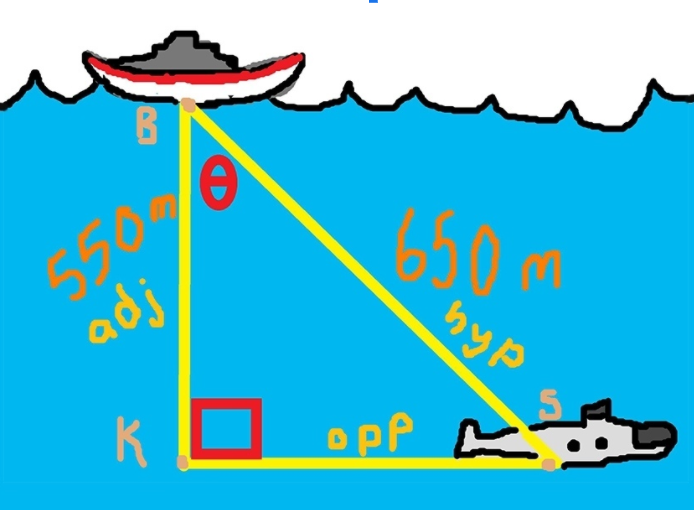
Day 4: We started with watching Boat Balls. Yes! Boatballs! (stopping and starting) and 

asking what do we notice and wonder? What do we need to know? What do we know? 

What is going on??? Then we annotated a silly worksheet that had a mix of everything on it. 

Then we learned about angle of 

depression and angle of elevation (or nether) and did some silly word problems


Day 5 we downloaded the AnglePro App. We went outside and students needed to measure 

the height of the flagpole, the height of the columns, the height of the columns in the library 

and one other thing, complete with drawings. 

Their CYU work was something I found in Ghana in 2009 or 2010 Called In the Park. 

The Students did this work and then had to draw in something that required the Pythagorean 

Theorem to solve. (So six Triangles) 


Day 6: PROJECT!!!! (I added they could make it digitally) 

 (At his point a DeltaMath Take Home Assessment was given due int 5 days time–a chipper) 

In groups of one, two or three, Students needed to create their own, “In the…” 

Magic happened! They got 2.5 days to work on them in class. Here is the rubric.

Make sure to check the sketch work before they commit it to the project. 

At the Met
Att the Christmas Market

We will see how much they remember from a three week winterbreak 

(First time kiddos were allowed to travel, so we got an extension for return quarantine if 

necessary). Happy New Year. If you use the project, please let me know how it goes.

Hello Friends! I hope you and yours are healthy and taking care of each other.

Yesterday we conducted teaching interviews online. From years of experience both on interview panels and being a successful interviewee, I thought I would share some pointers with you. Please share and please let me know when you get the job!

PS These are all real examples, I did not make any of them up!

Please do NOT:

1) assume teaching is causal and show up in jeans or wrinkled clothing. (Many re-entry programs offer free professional clothing)


2) start every sentence with Me, My, I

as in "My students love me or when I took the SAT..." or when asked how you will contribute to a team say, "I don't know..."

3) assume all students are created equal or have access to the same resources.


4) ask "Where are you located?" or "How many students are in your school?" or "What physical safety measures are in place in the classroom?"

5) answer tech questions generically as in "I love computers," and "Computers are very useful."
and finally, oh friend, when conducting an online interview, please don't show the shelves in your frat house living room.

Please Do these things instead:


  •  Do your research! All districts and schools have websites. Many have WASC reports or, in California, we have the The California School Dashboard. Check out a local newspaper for the school sports pages or what how the Oddessy of the Mind team did in their last competition. What was the last play, musical, or band performance of the school? Find a friend of a friend of a friend whose kid goes to the school. Know what curriculum they use in advance.


  • Show that you are committed to healthy, positive relationships with students. Be specific. Mention a student by name, a colleague by name, or talk about how you connected with a student's family. 


  • Have a good failure story. Make sure you talk about how you corrected course and who you reached out to help you.
  • Show how you are a team player. Mention common assessment, mention a time when you collaborated with another teacher or team of teachers. Be willing to contribute and learn.
  • Have some specific strategies for working with special populations (I mean they are all special, right?) Include awareness of limited English speakers, students with IEPs or 504s. 
  • Make sure you know the standards in your area of learning and especially the social/emotional curriculum that matches. 
  • Don't be afraid to be new to teaching. Your experience is important, whether it is coaching, military, or retail. Your work history shows your work habits, your ability to work with people, and take direction. 
  • Don't be afraid to show your years, and years, and years of experience. This is your moment! 
  • Remember that you are more than being interviewed, you are also making sure the organization is a fit for you. Have FUN! Smile! Know that even if you don't get the job, you will learn something valuable. 

Good Luck!!! 
Ever since I read about Stand and Talks on https://www.saravanderwerf.com/ (The amazing Sara Vanderwerf's website) they have become the single most important routine/device/exercise/strategy I use in my classroom. You can also hear about them in this Global Math Department's webinar:
Just like warming up before exercising in earnest, like if you take a class at a gym or are getting ready for a race, the coaches ALWAYS warm you up. "Run 500 meters." Then we stretch and THEN we exercise, Stand and Talks open students up. They warm up their minds and activate an openness to learning through safe dialogue with a partner first. I love them. 

What is a Stand and Talk? 
Here is my proposal for the CPM 2020 conference: (Still holding my breath, I was rejected, but asking to be included in some other way--advise accepted)

Stand and Talks--5 minutes that will reshape your classroom culture

Think/Pair/Share is a common go to strategy to give students a cognitive boost.
But what if instead of sitting, you could create a similar, potentially richer, easy access,
sky’s the limit, non-disruptive experience moving and standing? Stand and Talks take five minutes
and will increases math discourse, always gives a student something to share out, and shifts the
cognitive lifting from teacher to student. 

Stand and Talks begin with a prompt to look at and hold so there are no awkward silences.
The directions are simple, the possibilities are endless. I have used them for review, preview,
introduction, and vocabulary. I have used them as an icebreaker with students and with colleagues.
I have used Stand and Talks with Notice and Wonder, What is the same and what is different,
Examples and Non-Examples, Who did it better, and What can you label?
I was introduced to the this strategy by Sara VanDerWerf @saravdwerf
and I can’t wait to share it with you! As Sara says, “My goal is for students to say it before I say it.” 

_____________________________________________________________________________________________________________________________________________________________________________________________________________________________________________________________________________________________________________________________________________________________________________________

My directions are modeled after Sara's: You will be standing up and pushing in your chair
when I finish giving you the instructions. You are going to move at least 15 steps away from
your table mindfully and quietly with no devices or writing utensils.
You will find someone to partner with that is NOT at your table. If there are an odd
number of folks, someone needs to find me and I will tell you what to do. When everyone is
partnered and standing, I will give you a card with a picture, graph, or problem on it. You will find
at least 5 things to say about what is on the card. If you can't find more, repeat the ones you have.
You only have 90 seconds so we are not going to worry about who our partner is and you will not
complain about standing the entire time.

I walk around and listen, make sure the students are on topic, nudge them in their thinking. I also
can have "plants" for the whole class discussion that comes after. When the 90 seconds are up,
I ask students to freeze and then I give them a silly instruction for who picks up the paper copies on
the table in front of the room. "The tallest replaces the card and gets two paper copies, the one who
slept the longest, the one with the oldest living grandparent, the one who lives closest to school...(see
the community building there?)

When the students get back to their seats, we annotate them together. This can reinforce, re-engage
or front load a lot of student thinking! The oohs and aahs are super fabulous and a lot of good information
comes from not just the top students. We then glue them into our Everything Notebooks (see earlier
post). And move on with our day. 5-10 minutes max. (We have 95 minute blocks every other day)


They look like this on a half sheet of card stock:

1) I used this S and T just as I was introducing graphing a quadratic by complete the square. in Math 2 (CPM) (Used as
review for all things quadratic in College Readiness):

Here it is annotated:


2) I used this Stand and Talk for introducing piece wise functions in College Readiness: Thank you @ cluzniak @math_mrestrada


3) This is a beautiful student generated Stand and Talk from College Readiness:

4) This is another student generated Stand and Talk from the Spring Final for College Readiness.


5) This is one of my favorite Stand and Talks EVER. I wish I had done a pre and post for Math 2. This was at the end of Right Triangle Trig.

Here it is annotated:


6) I admit, I completely stole the next one. I thank @NatBanting. I used this with Math 2 (and again with College Readiness) introducing the Zero Product Property. 


Anything can be a Stand and Talk. I saw this on Twitter and wrote that if you take out the
original prompt and replace it with "What do you notice? What do you wonder?" you get a
really cool Stand and Talk.


Here is another image from @riehlt:

Gotta Stop, going down the rabbit hole...

Is there anything I should add? That you have questions about??? 


You know the boring lessons in Geometry about chords and tangents and the angles they form? 


Today I wanted to do something more fun than our usual good fun, and so I started these Chapter 10 topics with constructions of circles. 

"Let's use this tool and make some circles!" What else can you make with a circle? We did regular hexagon, Equilateral Triangle, 6 pointed star. 

Then the inspiration hit. I let them play. Meanwhile I started making circles and cutting out bits to look something like this:


Because I remembered an OLD geometry book that had this problem:
Remember that goodie? 

I handed everyone a piece and said, find the original size of your disk, your plate, your platter, your wheel, whatever it was that you found in at your dig site. 

I was excited, they were a wee bit...I will take it. At least they were a bit more open. I then gave each pair of students a property of circles poster to make. 
Happy Friday ya' all!
Today was a magical day of learning and camaraderie. I met the fabulous @allison_krasnow 
(Pretend there is a happy, smiling picture of two Ts lucky enough to meet in person after knowing 
each other from our beloved #MTBoS) We finished each other's sentences and "got" each other. We talked 
living in Nor Cal, what makes an elementary school great and what does part two of wherever we are in our 
lives look like.

Then we talked Math Intervention. Allison teaches middle school in urban Berkeley. I teach in Suburban 
Windsor. She teaches 7th grade math intervention, I teach, um, a class of 10th, 11th, and 12th graders. You 
would NOT at all be surprised how much those two classes have in common. Both have management challenges.
Both have students that lack confidence. Both have students with gaps in their math education. Both need more 
practice looking at operations with flexibility. Both have teachers with multiple preps and not enough band 
width to do everything we want to do in our math intervention classes. Both have white teachers, who for
the most part, don't share our students non-whiteness. We both agree that beyond the gaps, 
learning how to be students and advocate for oneself are essential keys to helping these kids believe in 
themselves not only as mathematicians, but as students. 

Being together today made doing a little more seem not so impossible. 

Allison does number talks almost every day. She asks students to keep a notebook. She grades them once per week. She 
Students need to write down a few of the strategies of others. She does this amazing tweak of @saradwerf 's 
Stand And Talks. Instead of holding card stock, she shows a short part of an instructional video, pauses, has the Ss move to talk to a partner about what they learned, heard, wonder, notice, then they get Ss get to sit ON(!) the desk nearest them and watch the second part. Pause video, stand and find a new partner, discuss, sit on desk, repeat. 

We talked about the confidence that comes from playing games. How we both wanted to spend more time playing board games, how we both dread how long it takes to teach the rules and the fear of managing game pieces, how we both have grants with money just for intervention support. I grabbed Maya Madness and Scan, and we played some quick rounds. Out came the phone, pictures snapped. (You are welcome Ebay Sellers). She will try using IXL or Delta Math to occupy 1/2 the class while she teaches game rules, then switch. 

I have done many things in my HS Math Support Class. I am the one with the 28 students from 8 different teachers, teaching 10th, 11th, and 12th graders taking Math 1 and Math 2. I have done Number Talks and Clothesline Math, Close Reading and Vocabulary Sorts, SSR and Activity Logs, and now I am on to the Math Question of the Day. I have a 33% of the student's grade based on a Delta Math Component. 50% of my students are still failing their math classes (not a proud stat for me) as they have D's and F's in at least 3 classes. 

I am in the process of interviewing each one of my students. Asking them how they feel about math, about how they are doing, and how they are being successful. I have access to all their grades so I know where they are being successful. I have interviewed several the teachers. The teachers talk about making the learning exciting (They teach Music and Integrated Science) and relevant. Folks I am trying. I want to learn what they need from an intervention class. Ah, from sharing this with Allison and her wish to be able to do the same, I came up with the idea of a Google Form for their Math teachers. "How can I support you?" And Allison and I decided this would be a good idea to give the question to the students also.

We both talked about the comfort of routines (see this post by @lisa_bej) and how we weren't so consistent about it, but thought it was good idea to be better about it. 

We shared other ideas like using the NY Times What's Going On in This Graph (we both had it bookmarked) and Allison is going to share with me her work with Fraction Strips. 

It was so helpful to know I wasn't alone, that there are amazing and generous and real and SMART folks at the other end of my keyboard and we look forward to the lucky chance to meet up again.

What do you do in your Support Classes that has a positive impact on your students ability to be students?


My College Readiness students did pretty poorly on their review test--topics from Algebra 2 that were supposed to be review. I am not proud to say this. I do believe I play a definitive role in their mediocre showing.  AND I saw them doing the problems in class! They were being so smart!
I was not expecting them to mix up exponents in simplifying radicals, I did not expect them to forget how to rationalize denominators, I did not expect them to refuse to enter


I did not expect them to thoroughly forget what we had practiced.

I just don't think their hearts were into it. I tried not to take it personally.

Here's what I did to try to turn this defeat into a learning opportunity:

I started by telling the students the truth: every single student put something intelligent on their paper. I was really impressed by that. Then I shared my favorite no:

Question 1: What is the same? What is different? Give at least five examples all together: (yes we practiced in class prior to the test!)


Student Responses: (x - 5) in the second one has an exponent and the first one doesn't. 

Next we talked about the nuances of academic vocabulary verses what is written. I used:

What is the same? What is different? Give at least five examples all together:

         terrible                       fabulous

After some low bar characteristics: they both have l's, they both have vowels for the second letter:
the students went deeper: both have 3 syllables, both are adjectives, both have eight letters,  they have different meanings 

I applauded them for using academic vocabulary and asked them what could they say instead for the polynomial function. 

I then showed them a list of possible mistakes: (Thanks Tina Cardone)

Next I handed back the tests and gave them a template for considering their work with all the topics we covered (same list I gave in the review sesh) Thank you Krystal Mills (Lessons From The Middle)
I did a complete test with them.


We looked at each problem and the topic for one student. Next they will look at the type of error they made and correct the problems they missed. I am giving the students an entire week to do the corrections because I want them to have time to access me, the web, and each other. I am hoping they will engage and learn.

I will do an exit survey and let you know if they did! 

How do you turn mistakes into learning opportunities?


Hello Friends!

I have been at a CPM workshop (Math 3) all week. I love geeking out and playing math with my colleagues. I love how we think of teacher moves the best ways we can facilitate student engagement and learning.

The trainer gave us a carousel activity where each group of teachers got a card and, using post-its on the back, we gave one or two possible answers to questions like these: 


I thought this would be an excellent way to have groups re-visit the individual team member roles of Facilitator, Task Manager, Recorder/Reporter, and Resource Manager early in the year. (Has anyone ever had their students "apply" for a role? Maybe this could be a fun way of creating groups if there was an equal distribution of 1st and 2nd job choices) 

So I started thinking about a carousel/post-it activity for the students that I would use after 3-4 classes of using and defining the roles:


One team member has gone ahead of the others.
The______________ could ask_________________.

What other questions would you like to see the students think about? 

If you use groups of 4 and have team roles that you find effective, what are they? 


Hello from Washington, D.C. Not my usual hood, but my daughter lives here and I get to visit this amazing city.

My head is swirling with history and observations from 5 weeks of traveling in Eastern Europe and then back to visit family in NY and DC before heading home to California. On this trip the hubs and I asked each other' "Why do you travel?" My response after a gigantic pause:

To Understand Time.
To Be an Ambassador of Peace and Mend Cultural Misunderstandings.
To Get Out Of My Comfort Zone.
Understand History from Place and Culture. 
Finding Beauty EVERYWHERE.


I have an earlier post < > where I contemplate my judgment of what teachers ought to bring to their students. I used to be in a state of dismay, that so many of the teachers at my large high school grew up in the same place they taught. I used to think this was unfair to the students. Our community can be fairly provincial. For example, we are 65 miles north of San Francisco and many of our students have never been to the city. Even though we are 40 minutes from the beach, some have spent very little time there. (Our students have a wide variety of experience, from traveling to Mexico each year, to a few who have been to Europe and Washington DC, to those will go as far as the lake for the summer)


Many of our teachers went to the local Junior College and Cal State Campus. Very few are from UC’s (Including myself) or from prestigious universities. I used to think our students deserved teachers who were worldlier, more academically, “high brow.”

Then I had an epiphany, that the local teachers spoke the student’s language. They show the students what IS possible. They possibly do a better job of meeting them where they are at. Maybe I was the one that made them uncomfortable, always challenging the status quo.


Some teachers relate to their students by reading YA fiction, some play country (cough) music all.the.time., some are into super 
heroes, some are into shoes and fashion, and some are so cool, they surf before school.
I am not at all hip.

I travel.

Here are some photos to go along with the reasons:

To Understand Time:

400 BCE Wailing Wall Jerusalem, Israel


To Be an Ambassador of Peace and Mend Cultural Misunderstandings:

Muslim Ladies taking their Children to the Beach, Hertzalia, Israel

Ifran, a Muslim, gave us an all day tour of Jewish Sarajevo.

Understand History from Place and Culture:

Those are shrapnel holes outside our amazing apartment in Sarajevo received during the 1992-1995 war. (up to 350 + average missiles on civilian targets daily for over 1400 days)


Finding Beauty:

 Left: Old Jaffa port manhole cover, Tel Aviv.


Below: Love is Love.


To Get Out Of My Comfort Zone:

Konjic, Bosnia. River Rafting on the Neretva River. Jump from 6 meters. (Love mostly because it turns our notion of “Bosnia” on its head) 


What did you believe that you no longer believe about what makes a teacher effective?

What hobbies and/or interests give you “creds” with your students?